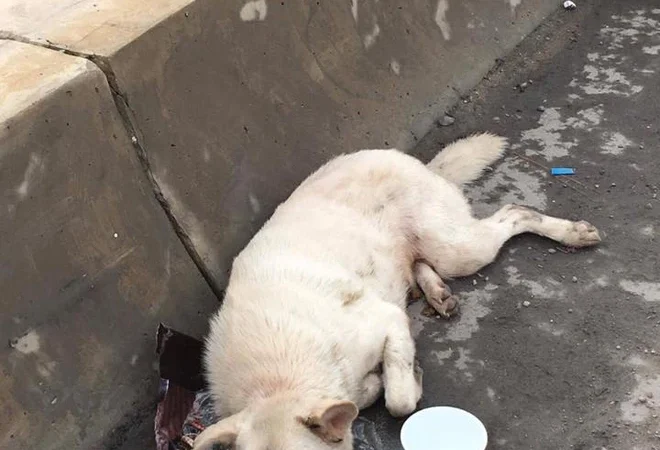
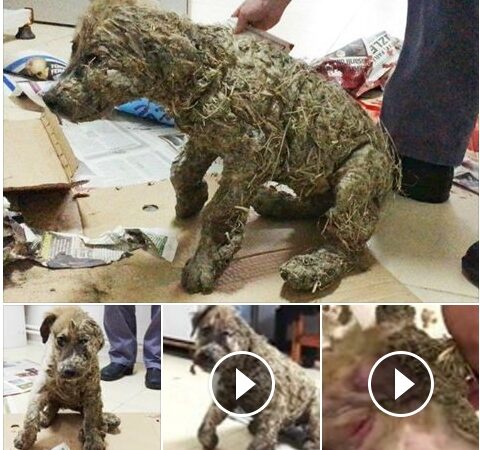
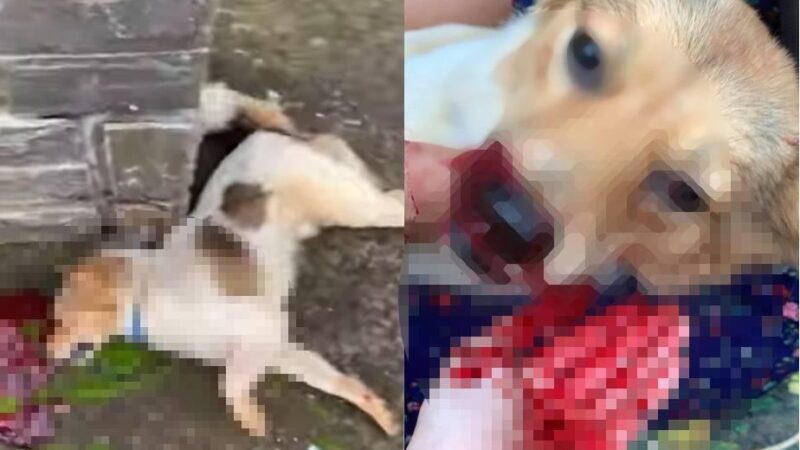
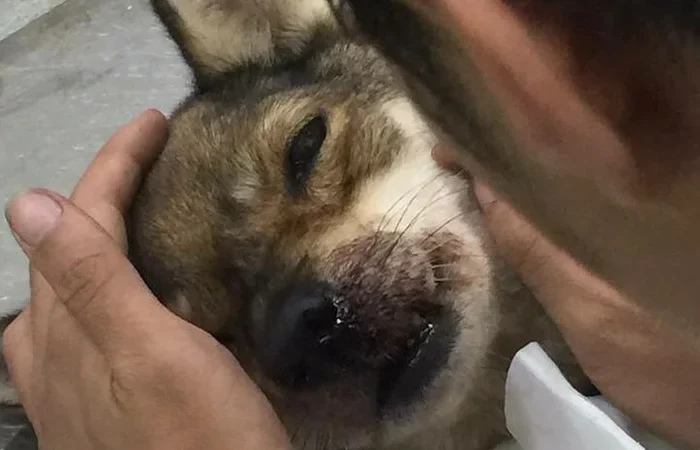
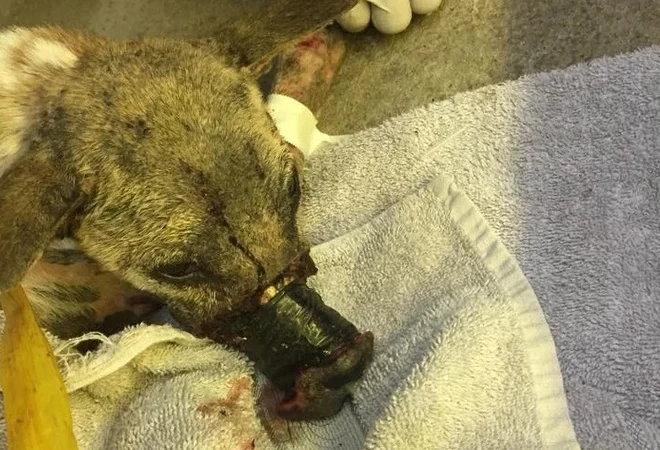
A dog narrowly escaped death after being tied up by a school security guard and allegedly prepared to be slaughtered for meat. Fortunately, some students discovered the situation in time and managed to rescue the dog.
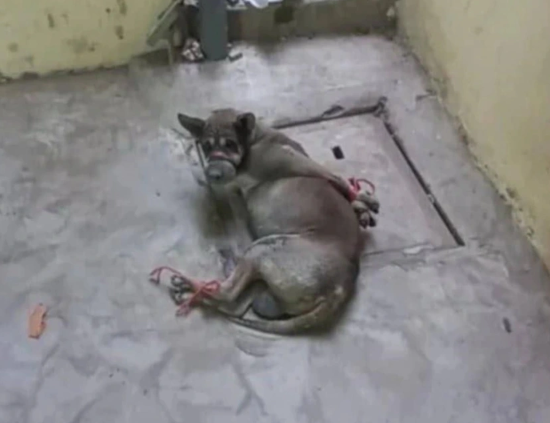
According to lawyers, muzzling and tying up an animal’s legs behind its back can be classified as cruel animal abuse. The applicable penalty is a fine of 1-3 million VND.
In recent days, social media has been abuzz with images of a dog tied up by its hind legs and muzzle bound at Kien An High School (Kien An District, Hai Phong). The posts speculate that the animal wandered into the school grounds and was caught and tied up by the security guard, Mr. NDG, before being taken away to be slaughtered.
After the information surfaced, many people expressed outrage and left harsh comments on the fan pages of Kien An High School.
Responding to a reporter from Dan Tri newspaper, Mr. G. confirmed that the dog was tied up at the school, but the incident was not as reported on social media. According to Mr. G., the animal had already been tied up and muzzled, and he bought it from a young man on the afternoon of March 18th. The security guard then temporarily left the dog in the school’s parking lot, where students saw it, took pictures, and posted them on social media.
Regarding Kien An High School, the school’s leadership stated that after receiving the information, they requested the security guard to submit a report to the school’s administration and the Ngoc Son Ward Police. Mr. G. admitted his गलती and requested to resign, terminating his contract with the school.
Commenting on the incident under Dan Tri ‘s articles , readers expressed differing opinions. Reader Tay Nguyen wrote: “The image of the animal being tied up within the school grounds like that is offensive and inappropriate for the current spirit of animal protection.”
“The security guard told the story like a fairy tale. I was hearing it for the first time, but even I couldn’t believe it,” said Ngo Phuong Nam .
“Extremely violent and offensive images appeared at the school, and the children, feeling sorry for them, posted about it asking for help. One might have thought the heartwarming story would end there, and that the children deserved praise, but the school secretary sent a warning message, threatening disciplinary action against the student who posted the images with unreasonable and achievement-oriented language.”
The final straw was the posting of the messages online, which angered the online community. If the online community hadn’t reacted so strongly, the students would probably have been disciplined. The school environment should be a place where children dare to stand up for what is right, not a place where they live submissively and cover up for others,” Huyen Vy Le emphasized.
Conversely, many opinions suggest that the incident has been exaggerated and blown out of proportion, as the law does not prohibit people from buying, selling, or eating dog meat. Dang Huu Phuoc wrote: “What’s the big deal? Vietnam doesn’t ban dog meat; buying and tying up dogs for commercial purposes is not wrong. If we use the excuse of animal abuse, then many, many people violate the law; they even beat or electrocute them to slaughter. Or is it only considered animal abuse in schools? The security guard was wrong for bringing animals into the school without permission from the school administration, and the school was hasty in handling the information.”
“Every citizen is allowed to do anything that the law doesn’t prohibit. Is tying up a dog or slaughtering a dog prohibited by law?”, Ngo Duc asked.
So, according to the law, is the above behavior a violation?
According to lawyer Quách Thành Lực (Director of Pháp Trị Law Firm, Hanoi Bar Association), livestock includes cattle, poultry, and other animals that are domesticated and raised by humans and are not on the list of endangered and rare animal species protected by law.
Previously, the act of beating or cruelly mistreating animals was considered a personal choice. Owners had the right to choose whether or not to engage in such behavior. However, since the Government’s Decree 14/2021/ND-CP on administrative penalties for livestock violations came into effect, this behavior has been classified as prohibited.
Accordingly, Clause 1, Article 29 of this Decree stipulates that those who beat or cruelly mistreat animals will be fined 1-3 million VND. Therefore, the act of muzzling or tying the animal’s limbs behind its back can be classified as a cruel act of animal mistreatment and is punishable by a fine of 1-3 million VND.
Furthermore, this Decree also stipulates that beating or failing to stun animals before slaughter is a violation and may be subject to a fine of 3-5 million VND.
“It is important to recognize that legal regulations prohibiting or permitting certain actions are formed from general rules of conduct, have general binding effect, and are called legal norms. Legal norms have both social and moral aspects.”
While sociality reflects the cognitive tendencies and psychological development of people in a society, morality expresses the views of individuals within a community on good, evil, justice, equality, and other categories belonging to the spiritual life of society.
These viewpoints are determined by the conditions of social material life. Based on these viewpoints, a code of conduct is formed. Social and ethical values, through the legislative process, are refined and elevated into legal norms,” lawyer Luc commented.
In light of current societal realities, lawyers recognize that the slaughter and consumption of livestock remains a widespread, long-standing practice that cannot be changed immediately. Until social and ethical considerations are fully addressed, enacting legal regulations prohibiting the slaughter and consumption of livestock is inappropriate given the current socio-cultural conditions and lacks practical feasibility.
However, this does not mean the law allows people to freely torture, abuse, and slaughter livestock. Clause 2, Article 29 of Decree 14/2021 stipulates a fine of 3-5 million VND for slaughterhouses that beat or fail to stun livestock before slaughter. Although this only applies to slaughterhouses, it contributes to limiting and reducing the arbitrary slaughter of livestock in Vietnam.